
National Public Health Week: DuPage Public Health From The Archives
Monday, April 6, marks the start of National Public Health Week (NPHW), and we will host a new traveling exhibit, Making a World of Difference: Stories About Global Health. According to the American Public Health Association (APHA), this week is “a moment to celebrate the impact of public health and spotlight priority issues that can improve our nation’s well-being. [Including] creating campaigns, materials and resources that help communities, schools, policymakers and health professionals engage with each year’s theme.”
Traveling Exhibit: Making a World of Difference

April 6–May 16
Around the world, communities, in collaboration with scientists, activists, governments and international organizations, are working together to prevent disease and improve quality of life. This exhibit will run from April 6 through May 16 on the 3rd floor during regular library hours. If you’re unable to view the exhibit in person, you can view it online through the National Library of Medicine.
Call the Doctor! Victorian Medical Practices
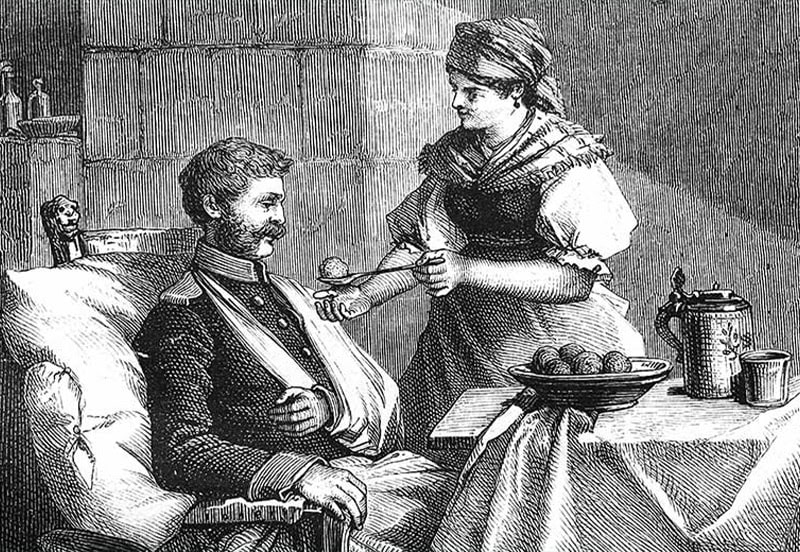
Tuesday, April 21, 7 p.m.
Learn about our nation’s health history in a special virtual presentation of Call the Doctor! Victorian Medical Practices. Victorians treated sickness very differently from the way we do today. Discover their remedies for diseases, peculiar treatments prescribed by doctors and how Civil War doctors treated battlefield injuries. Registration opens Tuesday, March 31.
Investigating Quarantine Guards
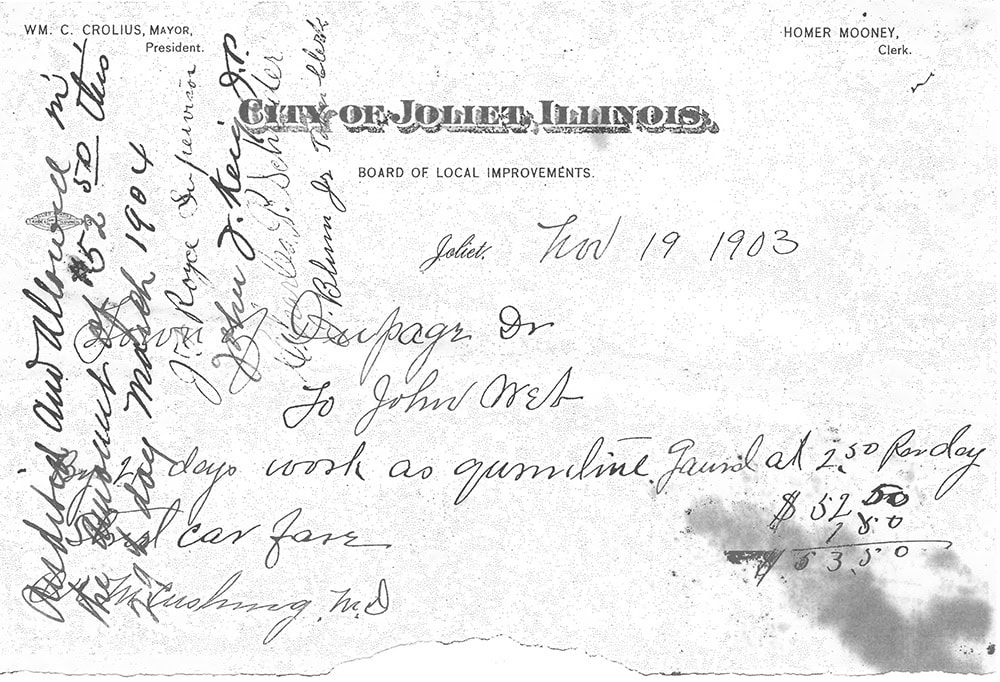 This is a timely topic for our library, as earlier this year, a member of our Bolingbrook Historic Preservation Commission sent a copy of a payment receipt from 1903 signed by a local doctor with a question attached: “What is this word and what could it mean?” Our librarian team in the Adult and Teen Services Department gathered around and took a look. We worked out a few possibilities, but none of them seemed quite right. Then we had a breakthrough; could it be “quarantine guard”?
As a genealogist, I have researched an array of professions; however, a quarantine guard has never shown up in my search results or in any document. While I could not find a job description specifically attributed to Illinois in 1903, I found a reference to this position relating to smallpox guards from Pennsylvania in 1904. It is likely applicable to other municipalities across the country. Given our experience with COVID-19, quarantine guards of the Victorian era were essential workers in their communities. Contracting smallpox was often a death sentence, and it was highly contagious. Given the tremendous danger to community health, large-scale immunization efforts began to emerge on a mass scale during the Revolutionary War. To protect his troops from this illness, George Washington mandated inoculation for all Continental soldiers in 1777.
Scheduled in twelve-hour shifts, guards were typically men. Quarantine guards were expected to prove their immunity to smallpox through a certificate of vaccination or evidence of having previously survived the disease. The last part of that requirement may have been achieved by a notarized doctor’s note from the individual’s primary care physician. Their primary duty was to ensure no one entered or left a quarantined home or building, such as a hotel, boarding house, railroad station, schools and other community buildings. From the description found in Pennsylvania, guards acted as a lifeline for those inside a quarantined building by fetching necessary supplies for “maintenance and comfort” and overseeing their safe delivery. They also had to ensure that quarantine warning signs were constantly and conspicuously displayed on the buildings. Guards were generally prohibited from entering the quarantined premises or having physical contact with afflicted individuals. Necessary communication was limited to speaking from a “reasonable distance” (aka social distancing) through open doors or windows, or via written messages read through closed glass. Guards were also responsible for preventing the removal of any objects from the premises. While not considered a physical role, the guidelines do outline the need for hands-on enforcement to keep individuals forcibly confined for the full duration of the quarantine period.
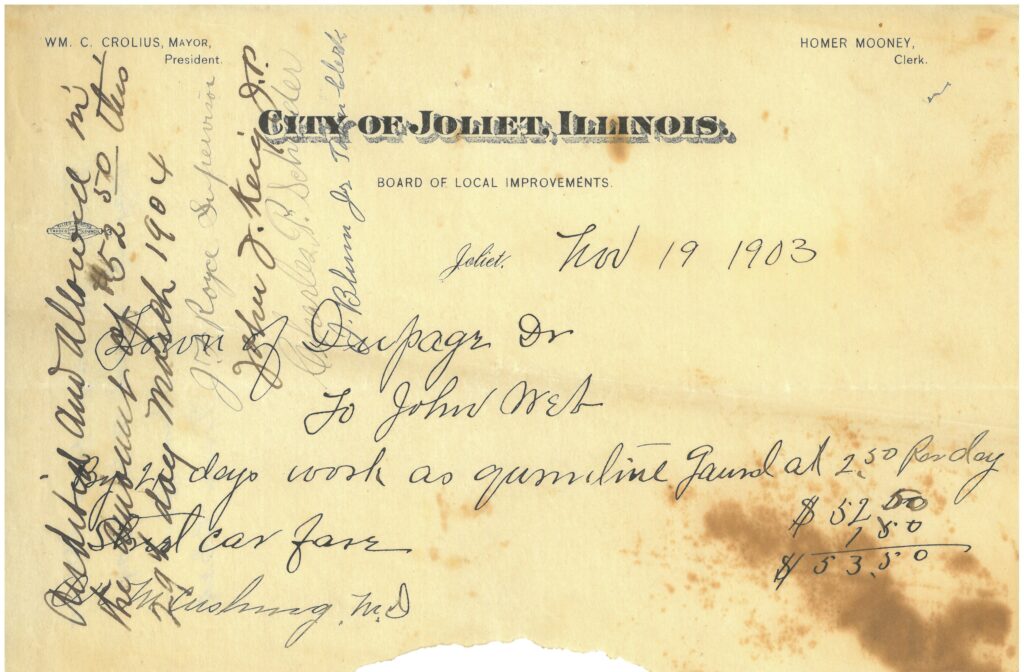
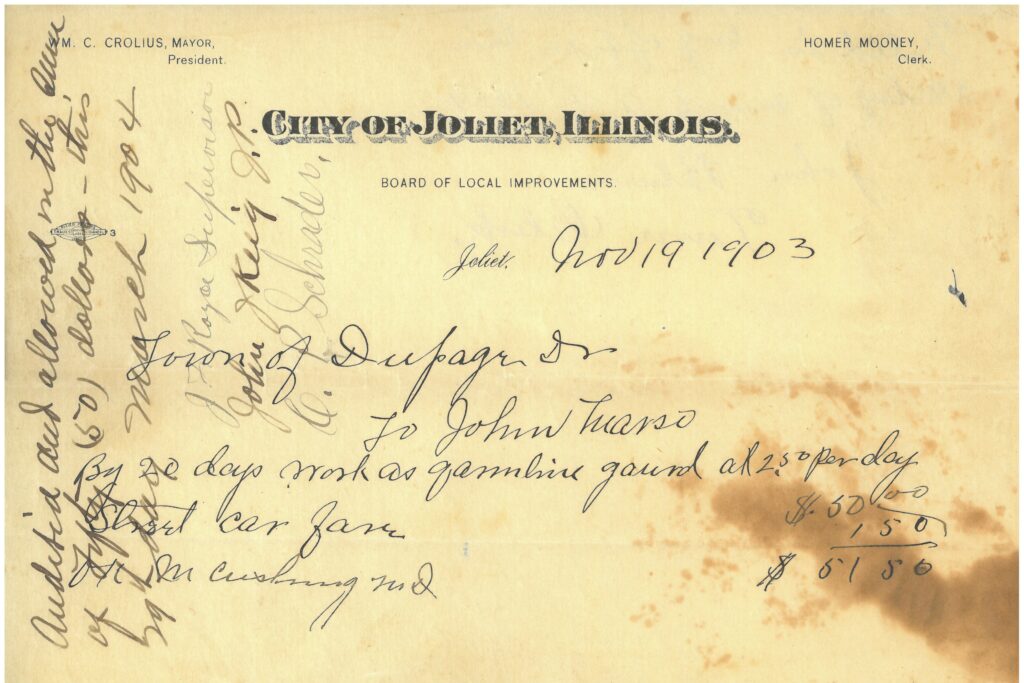
Smallpox was just one of the highly contagious communicable diseases our ancestors had to battle. Quarantine guards were called up when outbreaks of measles, influenza, diphtheria and polio appeared in communities. As we found in these receipts from DuPage Township, Will County paid for two quarantine guards in November 1903 to help contain a smallpox outbreak. Each man was paid $2.50 per day for twenty days. This was a period when the average income for an unskilled laborer ranged from $16–33 a month ($200–400 a year), and monthly family grocery bills averaged $5–9, so $50 for less than a month of work was a significant sum.
But what ties our community to this outbreak? Before the incorporation of Bolingbrook, this area was often referred to as DuPage, Fountaindale and Barbers Corners. Even rural farming communities like ours were mandated by the state to undertake exhaustive measures to protect public health. Here is an excerpt from the Joliet Signal article published on October 30, 1903:
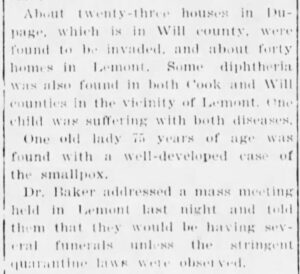
About twenty-three houses in DuPage, which is in Will County, were found to be invaded, and about forty homes in Lemont*. Some diphtheria was also found in both Cook and Will counties in the vicinity of Lemont. One child was suffering with both diseases.
One old lady 75 years of age was found with a well-developed case of the smallpox.
Dr. Baker** addressed a mass meeting held in Lemont last night and told them they would be having several funerals unless the stringent quarantine laws were observed.
* Sections of our community were lumped in with Lemont
** The chief inspector of the Illinois Board of Health
The state of Illinois did not require mandatory death records until 1916, which can impede research on this topic. There is a limited death index for the state compiled online by the Illinois State Archives, which is available to researchers for free. While helpful, it does not allow users to browse for deaths by location or date. Genealogists must deep dive into locally available death registers, sacramental records and burial records to locate victims of this outbreak. Even when records survive, they may not attribute a disease or affliction to the date of death. A look at some of the sacramental records available through the Catholic Diocese of Joliet collection on Ancestry, I was able to locate four children who died during this dual epidemic outbreak in November 1903. A majority of the causes of death for these deaths are blank. Only child, three-and-a-half year old Josephina Kambič, has a listing of diphtheria in her sacramental listing.
We can also see the impact of the outbreak in local school registers. The teacher’s register for Barbers Corners school indicates a majority of children missed school from October 26 through November 6. We could reasonably surmise their families were in quarantine at home, or their parents chose to keep them at home to prevent the spread of both diseases.
The November 1903 diphtheria and smallpox outbreak would not be the last health scare for our ancestors. Before the end of the Great War in 1918, they would experience the worldwide influenza pandemic, which would impact more than one million people in the state of Illinois.