
Ruby Reviews Fire Emblem: Fortune’s Weave
The demonic god of the underworld has all but won his war against the living. His undead soldiers devastate the land and its people. Worst of all, the champions who could have stood against him are under his sway. All of this could have been prevented. Maybe it still can be.
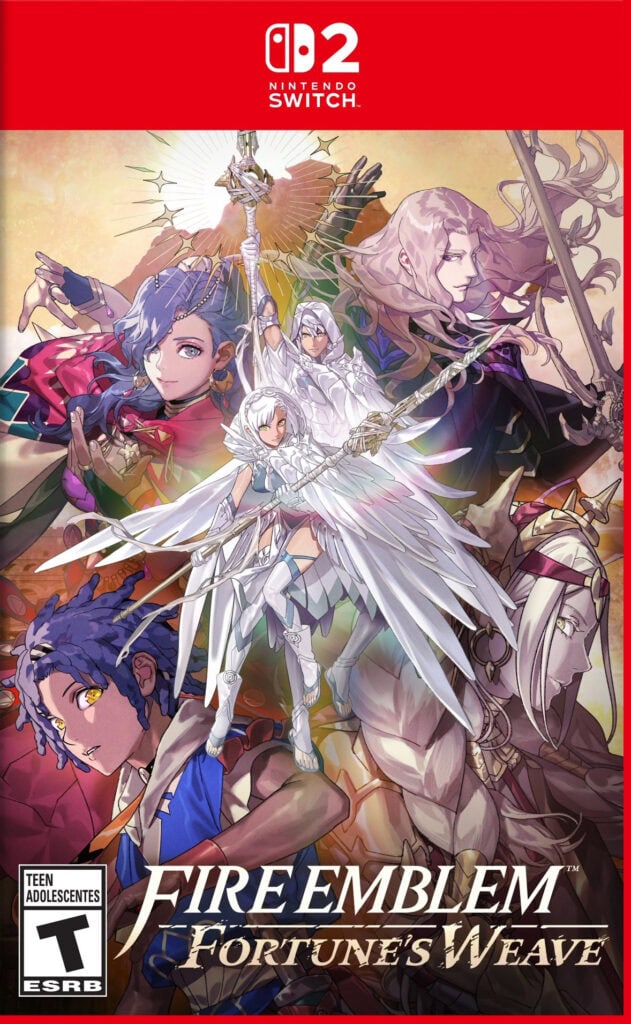
Fire Emblem: Fortune’s Weave
Platform: Nintendo Switch 2
Genre: Tactical role-playing
Release: 9/17/2026
Director: Toshiyuki Kusakihara
Artist: Chinatsu Kurahana
Developers: Intelligent Systems & Nintendo
Check our shelves for Fire Emblem: Fortune’s Weave
Quick Review: Fire Emblem: Fortune’s Weave is the tactical RPG franchise’s beefiest offering yet, with hundreds of hours of gameplay and story stretched across four paths featuring four distinct champions. Leda’s path, in particular, is a compelling story of a woman passionately devoted to her quest for revenge against her father’s murderer. The grid-based tactical combat greatly benefits from over 30 years of quality-of-life innovations, making this one of the smoothest and fastest-paced experiences I’ve had in the genre. World map and dungeon exploration add a change of pace without overstaying their welcome, while the hub city provides a gorgeous backdrop for the intriguing characters to inhabit. With a compelling story, highly polished gameplay and a truly impressive amount of things to do and see, Fortune’s Weave is totally worth your time.
Franchise History
Fire Emblem is a series of tactical RPG games first published in 1990, but North America would not officially be exposed to the franchise until the character Marth appeared in Super Smash Bros in 1999.
Four years later in 2003, Fire Emblem for the Game Boy Advance, retroactively subtitled The Blazing Blade, would become the first Fire Emblem game released in the US, and the franchise would go on to see modest success for the next 10 years.
One of the franchise’s iconic features is permanent death of characters who fall in battle, as opossed to other RPGs that include revival through spells, potions and other mechanics. Fire Emblem’s take on character death severely punishes the smallest mistakes. But longtime fans might argue that this is precisely the point. The challenging gameplay and potential for a sudden, tragic end to your favorite character’s story is a huge appeal of the franchise. But that could also be a hard sell for someone outside the existing Fire Emblem fanbase.
In 2013, Fire Emblem: Awakening changed everything when permanent death became an optional setting, making the game easier for new fans to get into the series. Awakening also greatly expanded on support conversations, a mechanic where characters come together to unlock special cutscenes that expand their relationship. This opened the franchise to fans of visual novels and relationship-focused RPGs like the Persona series. Together, these changes exploded the popularity of the franchise.
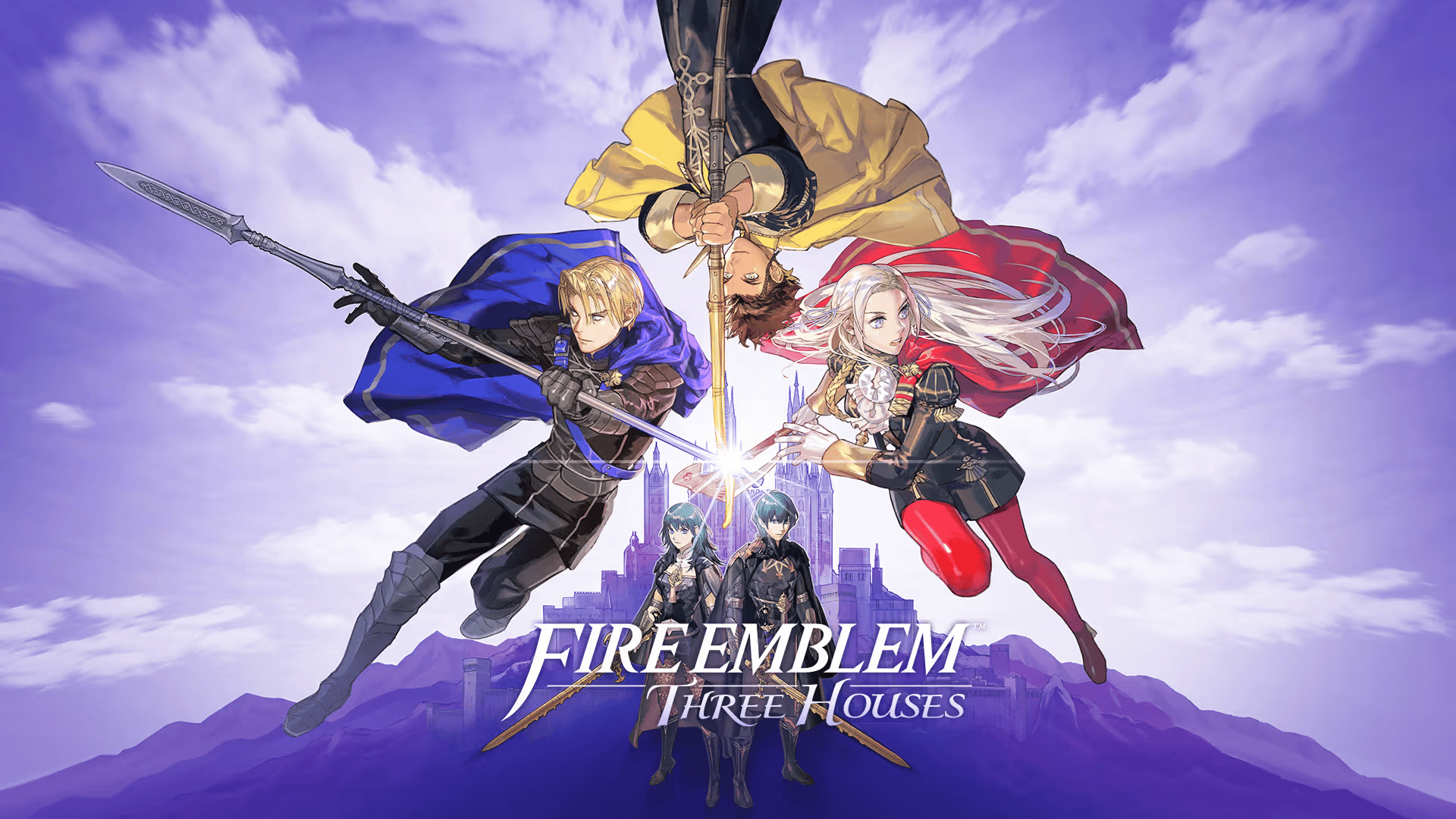
Subsequent games also enjoyed success, but it was 2019’s Fire Emblem: Three Houses that locked in the greater gaming fandom tighter than ever before.
The conflicts in Three Houses are deeply personal, with our three leads becoming the villains of one another’s story. In particular, Edelgard stands out as a character who has much in common with the villains of previous Fire Emblem titles, yet she’s a character you can choose to side with, and the narrative gives you compelling reasons to do so.
This moral complexity was greatly welcomed in a game series where the final boss is usually some Great Evil that the unproblematic noble heroes must defeat so everyone can live happily ever after. Fortune’s Weave continues this moral complexity.
Setting
Fortune’s Weave takes place in the same world as Three Houses, albeit hundreds of years later and in the neighboring continent of Dagda. While most kingdoms in Fire Emblem are inspired by central and western Europe, Dagda stands out for taking its inspiration from Mediterranean peoples and cultures. The game does justice to the real-life cosmopolitan nature of the Mediterranean by featuring Greco-Roman architecture, flamenco music and a variety of skin tones on the playable characters and NPCs alike.
Fortune’s Weave is also distinct in how it portrays the pantheon of Dagda. The gods live among humans as rulers and religious leaders, with the sun god Solel ruling over the Dagdan Empire. In honor of his father—the god for whom the continent and Empire are named—Solel is holding the Heroic Games, a nine-month fighting tournament featuring the main playable characters as contestants.
The story so far…
The prologue starts the player’s avatar in an apocalyptic world where Balor, the God of the Underworld, has all but won his war against the living. The only hope is to travel back in time five years to the last Heroic Games and ensure that the four champions of that contest live long enough to join the battle against Balor.
You have four paths to choose from, but you’re free to focus on a single path or bounce between the four. The game gently encourages you to complete each of the four paths before moving on to the next section of the game, as having all four champions at your side will give you the best odds against Balor. But this is optional, so you can adjust the difficulty of the final chapters while also experiencing small differences to the story.
I chose Leda’s path, which I’m roughly 40 hours into, and I’m still not finished. So, seeing as I’d prefer not to wait 10,000 years to make this review and would prefer to keep said review a reasonable length, we’re just going to focus on Leda’s story for the rest of this section.
“Leda” is the alias of Leilidahna Guillermo Cohendia, daughter of the Viceroy of Cydonia. Leda’s father was killed by a man named Bertrand during the Cydonia Massacre, in which one of the empire’s vassal states took over the region and slaughtered many of the locals. Years later, Leda travels under the guise of a dancer, seeking revenge against Bertrand and the conspirators who put together the Cydonia Massacre.
Unlike other revenge-driven characters, Leda is not dark and brooding—she exudes euphoria as she crosses out the name of her recent target with their own blood. Her hatred for Bertrand in particular is frequently compared to love—fervorous, passionate, all-consuming. She sees him when she closes her eyes. She dreams of him. She yearns to be reunited with him. She can’t even imagine her life without him. It’s a fresh and disturbing take on a revenge-driven character, enhanced by excellent voice acting and expressive animations.
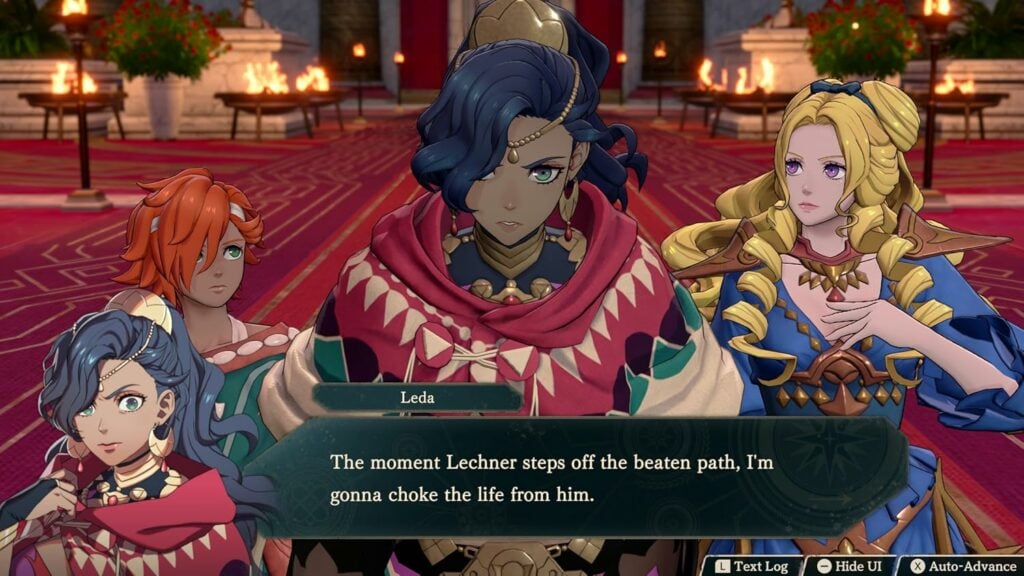
Leda’s main supporting cast includes Buccar, her loyal guard and servant; Sirocco, a flirtatious temple spy; Olympia, Leda’s artistic rival; and Mu, a mercenary’s daughter with a crush on Leda.
Mu is a particular favorite of mine. For one thing, I like when video games are so forthcoming with their queer characters. After grown up with queerness being ignored at best and mocked at worst, this is a welcome change. Her character also greatly enhances Leda’s, as a good supporting character should.
The presence of a young teenage girl does little, if anything, to soften Leda’s approach to her revenge. One of the first things Leda does in front of Mu is kill a man and use his blood to strike out his name on her list of targets. This moment in the game shows how deep Leda has sunk into her obsession for revenge. We also see Sirocco’s surprising maturity as he comforts Mu, and Buccar’s concern and devotion to Leda.
While I can’t say the storytelling is always at this level of subtle complexity, the high points are frequent enough to make for an entertaining story overall. And all of this is less than one-fourth of the overall story.
Gameplay Loop
It’s probably a bit unusual to get to the gameplay this late in a video game review, but having at least a rough idea of the story helps explain the gameplay loop. Said loop goes like this:
- Chapter introduction
- Main battle scheduled in X amount of turns
- Use X amount of turns to level up, explore and advance Support Conversations
- Participate in main battle
- Fallout/rewards from events of main battle
- Repeat
Turns do not advance while you are inside the hub city, so you’ll likely do a lot of activities there before setting off for the world map, where turns do pass each time you travel a certain distance. Activities in the hub city include raising the support level between characters by giving gifts or having the characters do activities together, serving the gods to earn blessings, training your skills, buying weapons and items or simply exploring the city and picking up small resources along the way. Activities on the world map include searching for resources, completing side-quests, fighting bands of bandits or wild animals and exploring dungeons, among many other things.
Combat on the world map and in the main battle of each chapter is the classic Fire Emblem grid-based, turn-based combat simulation the series has had since the beginning, albeit polished to a golden sheen after more than 30 years of quality-of-life innovations. While the Switch 2’s new functionality lets you use your Joy-Con controller as a mouse, the stick movement during combat is so buttery smooth that I haven’t really felt a need to use it. I often find that even when the battle lets me use up to 8 characters, I can get through my turns pretty quickly, making for a pleasantly snappy experience I wasn’t expecting from a strategy game.
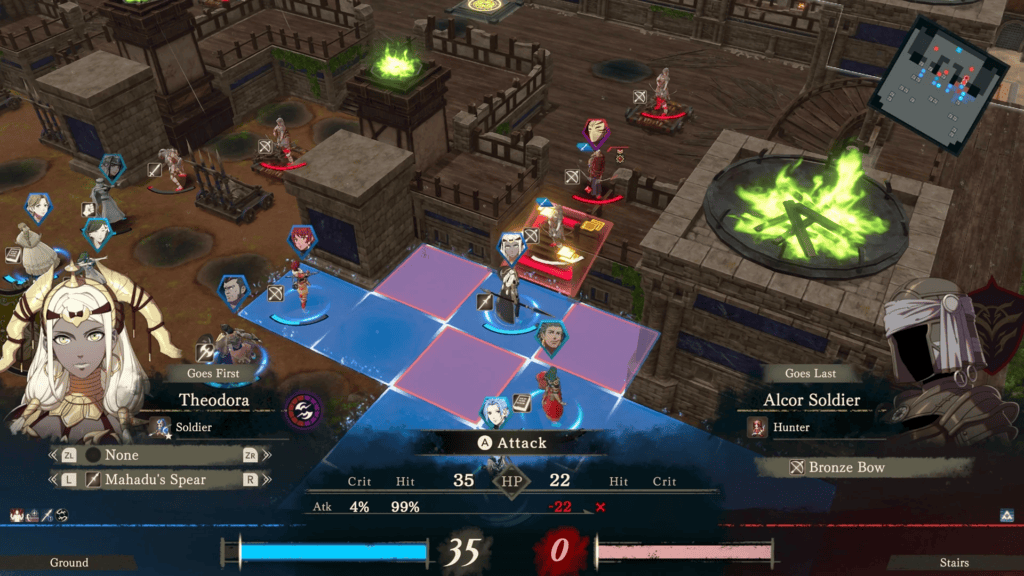
As is traditional with Fire Emblem, weapons interact with each other differently in a rock-paper-scissors kind of dynamic where swords have an advantage over axes, axes have an advantage over lances and lances have an advantage over swords. Bows and arrows deal extreme damage to flying units but are unable to counterattack when attacked from an adjacent square. Flying units, in turn, have the best mobility and are not slowed down or damaged by any difficult terrain, but have that weakness to bows and arrows. There are other interactions as well, such as heavily-armored troops taking zero damage from light weaponry like arrows but normal damage from spells.
Dungeon exploration features a different type of combat. You always have a party of five characters, and they engage in Final Fantasy-style turn-based combat, with no grid. Each turn, you can decide which of your team members will attack. This choice takes advantage of the weapon interactions mentioned above, so you’ll want to make sure you have a variety of weapons to choose from. You also have a limited pool of points you can use to do “Link” attacks, which can have two characters attack together, one attack while the other heals, or have one character attack while the other both attacks and defends at the cost of a massive amount of points.
The dungeons themselves are quite simple, so exploration has the potential to feel repetitive. However, all the ones I’ve encountered so far are quite small, so none have overstayed their welcome. It’s not my favorite part of the game, but I do enjoy the variety it adds.
In addition to all of that, the four main characters have unique abilities in combat and special tasks they can perform to collect resources. Leda’s combat abilities allow her to give massive boosts to allies’ stats each turn at the cost of some health—a cost each main character pays for their unique abilities. Her unique task is to travel to various locations and perform in taverns to earn a large amount of money.
I haven’t experienced the unique tasks of the other characters, but you get to control them briefly during the tournament fights, so I did get to see their unique combat skills. Cai can cast area-of-effect spells, Dietrich can teleport and attack after already using up his movement that turn, and Theodora can rip a chunk of earth out of the ground and hurl it in a straight line for a long-distance attack.
As you can see, Fortune’s Weave has a lot to keep you occupied with gameplay alone, and then has a massive amount of story content piled on top of that. So this game will definitely keep you busy.
Conclusion
With the massive amount Fire Emblem: Fortune’s Weave has to see and do, it’s quite impressive that so much of it is so well executed. A title like this easily could have been crushed by its own ambition. This is likely thanks to Intelligent Systems, the usual developer of Fire Emblem, opting to co-develop the game with Nintendo, who normally only acts as publisher. That choice led to an absolutely massive game, the quality of which matches its quantity.