
A Witch’s Life in Mongol: The Manga Behind the Upcoming Anime
In the medieval Iranian city of Tus, an enslaved girl named Sitara lives with and works for a family of scholars. Despite her status and her justified anger at her lack of freedom, Sitara lives in a gilded cage. The widow of the family treats her like a daughter, the uncle educates her and the son seems smitten with her. But that gilded cage is smashed when the Mongol Empire invades West Asia.
Seeking revenge, Sitara uses her real education and her feigned noble birth to get close to Sorghaghtani Beki, wife of Tolui–the heir apparent to Genghis Khan and murderer of Sitara’s masters.
But a flashy name like Sitara won’t do for a woman supposedly from a wealthy family. Fortunately, she already has a new name in mind.
This is the story of Fatima, one of the most influential figures in the early Mongol Empire.
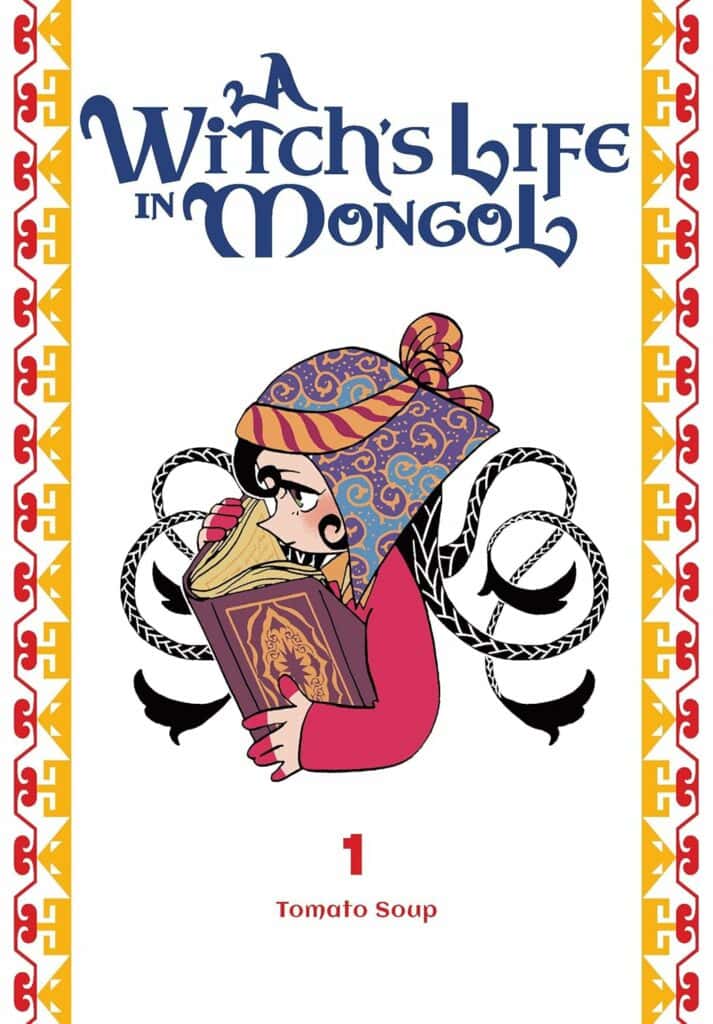 Quick Review: Approaching history with a nuanced yet principled lens, this historical fiction series tells the story of a woman’s personal and political struggles in the early Mongol Empire. A fictionalized interpretation of Fatima’s early life conveys the very real struggles of enslaved people in medieval Iran and of people conquered by the Mongol Empire.
Starring a historically maligned Muslim woman as its lead, this manga tackles a highly unique subject when compared to its contemporaries. There’s nothing else quite like A Witch’s Life in Mongol, and I highly recommend you give it a shot. Educationally engaging and emotionally enthralling, this is a must-read for historical fiction fans.
Find a Copy of A Witch’s Life in Mongol
Truly Unique
Normally, this is where I discuss the cultural and historical context of the book I’m about to review, and one would think it would be even more appropriate to do so when talking about a historical fiction manga. But there are a few things that complicate this discussion in relation to A Witch’s Life in Mongol.
For one, the cultural significance of this story is almost too obvious to mention—when have you ever seen a manga about a Muslim girl? They exist, but in small numbers and are rarely, if ever, distributed internationally. But A Witch’s Life in Mongol is not only being published internationally, it’s getting an anime adaptation under the English title Jaadugar: A Witch in Mongolia. A story like this coming from Japan and making it this far on the international stage has never really happened before.
As for the historical context, this can be a bit tricky to discuss in relation to historical fiction. For one, talking about the historical events relevant to this story might give away too much information to those who want to be surprised by the story. On the other hand, the events of the manga’s first volume are so divorced from known historical facts that it probably wouldn’t be that helpful to talk about them, anyway.
So rather than diving deep into the history of Fatima and the Mongol Empire, let’s talk a little about the value of historical accuracy—or lack thereof—in fiction.
Dramatizing History
As far as I’ve been able to research, the historical Fatima’s early life is not known to us in the present day. As such, the entire first volume of this story is fabricated. However, that doesn’t mean the story comes from nowhere.
It is true that she was from Tus and that a detachment from Tolui’s army attacked Tus during the Mongols’ invasion of West Asia. It’s true that Tolui boasted about killing most of its populace, though it should be noted that the Mongols are famous for exaggerating their kill-counts. It is also true that Fatima was brought from Tus to the Mongol capital as a slave, as were many women. But her true name of Sitara, and her life with her previous masters were, as far as I can tell, created by the author.
That said, Sitara’s experiences both as a slave in Tus and traveling with the Mongols to the Eurasian Steppe are based in reality. Sitara’s idyllic gilded cage is based on classical Islamic law regarding the treatment of slaves, up to and including her mistress accepting her as one of the family. The Islamic value of seeking knowledge is an important plot point and theme of the story, and this, too, is historically and culturally accurate.
As for the Mongols, we learn alongside Sitara as she discovers their social structures, their daily life and the ingenious construction of their yurts. All of the information presented to us by the story is firmly grounded in reality.
Historical Accuracy

A Witch’s Life in Mongol is an excellent example of how a story can take a great deal of liberties with historical events, but not necessarily be “inaccurate.” The historical Fatima may not have had these experiences, but someone from that place and that time period almost certainly did. Sitara represents not just the historical Fatima, but the women of Tus as a collective and the broader experience of being a woman ripped away from her homeland by war.
In historical fiction, most inaccuracies have a purpose. In the 2015 film Selma, President Johnson’s and Dr. King’s complex relationship is somewhat simplified so that Johnson can represent the moderate white holdouts King had to contend with when trying to achieve equality for Black folks.
Meanwhile, the film Lincoln contends that President Lincoln and his allies did, in fact, lie, cheat, steal and bribe their way into abolishing slavery. The political wheeling and dealing to pass the 13th Amendment is exaggerated into outright thievery and treason, emphasizing and dramatizing the dedication of the Abolitionists and their allies to the cause of ending slavery.
These inaccuracies still reflect reality, just in less literal ways. They represent the emotional reality of the moment, the zeitgeist that influenced the actual real-life events. So while it’s perfectly valid to dislike historical fiction for its tendency to bend the truth to tell a good story, I think it’s more fair and more important to instead think critically about why the inaccuracy is being told. Doing so allows the reader to engage with the story’s ideas—to meet the story halfway and have a conversation with it, rather than dismiss it outright.
Knowledge Defeats Bigotry

A big part of the reason why we need to think critically about historical inaccuracies is that a significant number of common historical inaccuracies can promote bigoted or insensitive ideas regarding race.
The aforementioned Lincoln, for example, has been understandably criticized for depicting Black people as passive in their own liberation. Meanwhile, the 2006 film 300 is infamous for depicting the Persian Empire as a horde of literal monsters.
Both of these films are still worth watching, but it would be wrong for me not to acknowledge how these depictions contribute to harmful misunderstandings and myths.
As I read A Witch’s Life in Mongol, I couldn’t help but think of 300 and wonder if the Mongol Empire would be depicted in a similarly unflattering light. But what I saw was quite the opposite.
Despite her justified anger at the empire, Sitara can’t stop herself from being impressed by the Mongols’ ingenuity and wisdom. She has to tell herself that it is merely the wisdom of “barbarians,” lest she come to care for and respect these people.
Even more damaging to Sitara’s desire for revenge is the respect she receives in her new home despite her status and gender. The Mongol statesman Chinqai speaks with her as an equal, respecting her intelligence and wisdom. She is offered opportunities to climb up the social ladder that she never would have been afforded in Tus.
The Mongol Empire did horrible things to Sitara and her loved ones, yet she can’t blind herself to the fact that they are people with their own culture and values, some of which she finds preferable to what she knew before. The empire is a brutal conqueror, yes, but it is also so much more than that. And a woman as smart as Sitara can only pretend otherwise for so long.
The Nuances of 13th Century Life
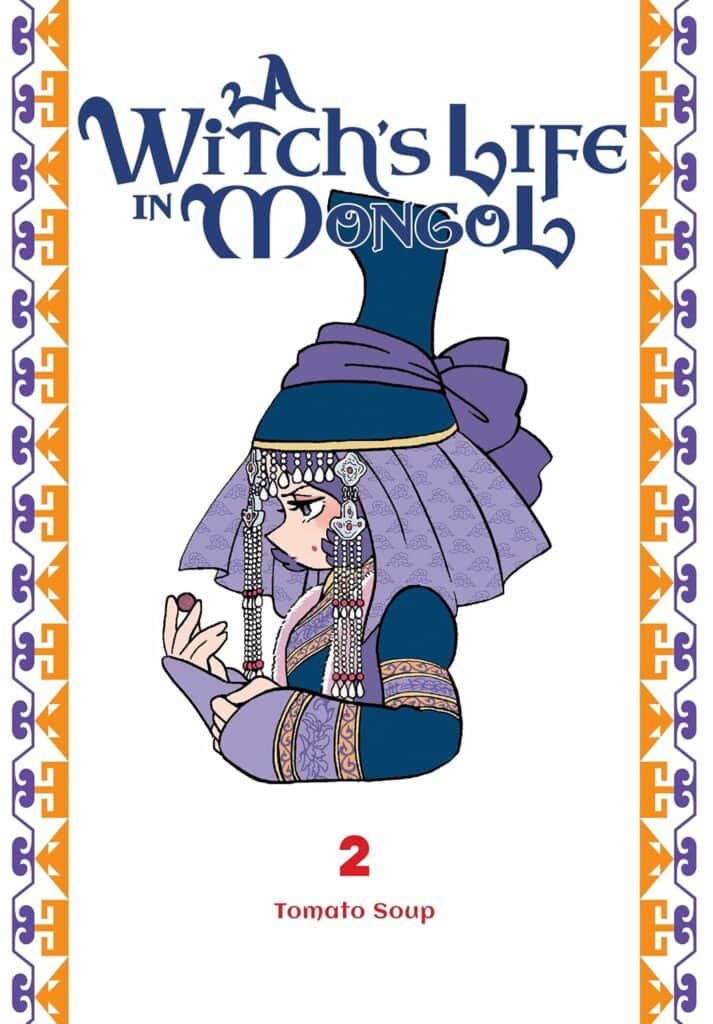
This nuanced view of history and culture does not end with the Mongol Empire, but extends to Sitara’s life in medieval Iran. Sitara’s life in Tus was happy, but her new knowledge of how other cultures live brings out her frustrations with that life. She lived as happy a life as a slave possibly could, but if she had remained there, she would have been a slave forever. While the young master of the house was permitted to go out and expand his education, Sitara would have never been offered that opportunity.
Both cultures are depicted as they were, neither demonized nor lionized. Yet it isn’t neutral regarding the flaws of either civilization, showing how Mongol society could produce a brutal oaf like Tolui or how medieval Iran could produce Sitara’s kind, yet patronizing masters.
When one tries for a neutral depiction of history, it’s easy for that “neutrality” to end up serving the power structures that oppress us. If you fail to comment on injustice, you end up passively supporting that injustice, whether you want to or not. “Bad men need nothing more to compass their ends, than that good men should look on and do nothing.” (John Stuart Mill, 1867)
Conversely, proclaiming an entire civilization or time period is “good” or “bad” is unhelpful and unproductive, so a certain amount of neutrality is desirable. What is needed is a principled neutrality, where the sins of the past are not downplayed but are also not treated as the whole story. Striking that balance is extremely difficult even for professional historians to achieve. I am deeply impressed that the author of A Witch’s Life in Mongol managed to do just that.
Inspired by the Classics
The author cites medieval manuscripts as inspiration for the story’s art, and you can certainly see the influence in the elaborate and highly detailed attire of important figures. What immediately caught my attention, however, was the clear influence from classic 50s, 60s and 70s manga creators like Osamu Tezuka, Shotaro Ishonomori and Go Nagai. This caught my attention right away, as I’m a huge fan of anime and manga that evoke a classic mid-century manga look. Anime like The Big O and Android Kikaider: The Animation evoke a unique atmosphere and aesthetic by drawing from the works of the old masters of manga, and A Witch’s Life in Mongol accomplishes the same thing.
The art displays intense emotions both subtly and overtly, helping the reader feel everything that Sitara is going through. The landscapes capture the sheer, massive size of the Eurasian continent, emphasizing the loneliness of Sitara’s journey and captivity.
Conclusion
 A Witch’s Life in Mongol is educational, nuanced, heartbreaking and thrilling with well-crafted art inspired by the masters of manga. It makes skillful use of artistic liberties with regard to history to tell the story of a girl surviving and potentially thriving in the face of losing everything. Its art is evocative and its story is enthralling, pulling you into the emotions of its main character. It doesn’t shy away from the dark side of history, and it neither condemns nor absolves the perpetrators of violent acts and institutions. It conveys history with an even, yet principled hand—a monumental task that even professional historians struggle to achieve.
For fans of historical fiction, especially when such fiction highlights maligned women, I can’t recommend this title enough. And check out the animated adaptation later in 2026!
Check out these similar titles!
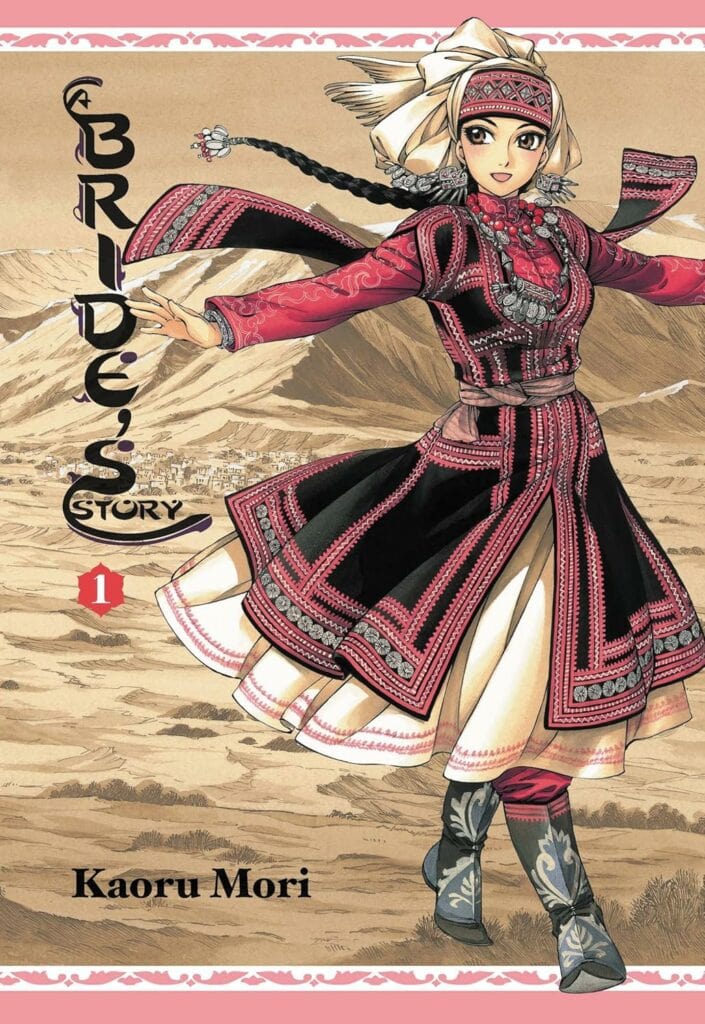
- A Bride’s Story by Kaoru Mori: Near the Caspian Sea, Amir gets to know her young fiancé as the looming threat of the Russian Empire draws near.
- Emma by Kaoru Mori: Victorian housemaid Emma falls in love with a wealthy merchant’s son.
- Yona of the Dawn by Mizuho Kusanagi: Yona, princess of Kouka, flees from her home following a violent coup, but fights to protect the kingdom.
- The Secret History of Mongol Queens by Jack Weatherford: A nonfiction book about the queens of the early Mongol Empire.
- Mobile Suit Gundam 00: The 2007 installment of the famous Gundam series, 00 (pronounced “Double-O”), draws heavily from real-life conflicts in the Middle East and features a Kurdish lead with prominent Muslim supporting characters.